

Vision & Mission
Vision
AY 2025-2026 onwards
To be a globally recognized centre of excellence in Artificial Intelligence and Data Science education, fostering innovative minds who leverage cutting-edge technology to create sustainable solutions for societal challenges while upholding the highest standards of professional ethics and academic rigor.
AY 2020-2025
To be globally recognized for contributing professional and ethical engineers in the field of Artificial Intelligence and Data Science with commitment to industry readiness and potential for research.
Mission
AY 2025-2026 onwards
- To deliver excellence in AI and Data Science education through innovative pedagogy, industry-aligned curriculum, and state-of-the-art infrastructure while fostering continuous learning and professional development
- To nurture technically competent professionals with strong analytical, problem-solving, and research capabilities through hands-on experience and expert mentorship
- To promote research culture and innovation by encouraging faculty and students to undertake cutting-edge projects and develop solutions for real-world challenges
- To establish robust industry-academia partnerships for enhancing practical learning experiences while instilling ethical values and social responsibility among students
AY 2020-2025
- To provide problem solving and analytical skill-based education to students that will enhance their expertise in the field of AI and DS through industry collaboration and research.
- To develop skilled and ethical professionals who are capable of providing AI and DS based solutions to societal challenges.
- To equip students for gaining mastery in the art of mathematical, computational and modelling methodologies and contribute towards innovation in the field of AI and DS
Program Specific Outcomes
AY 2025-2026 onwards
AY 2020-2025
By the end of the educational experience our students will be able to:
- To analyse and apply mathematical, computational and modelling methodologies related to Al and DS.
- Implement Al and DS techniques such as data analytics, machine learning, search algorithms, neural networks and design novel algorithms to solve practical problems.
- Apply the acquired technical skills in the multi-disciplinary areas of Al and DS such as health care, education, agriculture, intelligent transport, environment, smart systems, etc.
Program Educational Objectives
AY 2025-2026 onwards
PEO 1: Graduates will demonstrate expertise in analyzing complex real-world problems and develop innovative solutions using AI and Data Science techniques, while effectively integrating multidisciplinary approaches and entrepreneurial thinking.
PEO 2: Graduates will excel as professionals by exhibiting strong leadership qualities, effective communication skills, and collaborative abilities, enabling them to become successful practitioners or entrepreneurs in the technology sector.
PEO 3: Graduates will emerge as socially responsible professionals who leverage emotional intelligence and ethical principles to make positive contributions to society through technological innovations and business ventures.
PEO 4: Graduates will pursue continuous professional development through lifelong learning, adapting to emerging technologies and evolving industry demands while advancing their careers in technical, managerial, or entrepreneurial roles.
AY 2020-2025
- To train the students in formulating, analyzing, designing and deploying real world problems with a strong foundation in Mathematics, scientific and engineering fundamentals to meet the ever-increasing demand from the AI and DS sector.
- To build technical skills, soft skills and competencies to collaboratively work in multi-disciplinary projects and diverse professional activities
- To equip graduates to contribute ethically to the needs of society.
- To inculcate students with the ability to engage in independent and life-long learning in the context of technological changes.
Program Outcomes
PO1: Engineering Knowledge: Apply knowledge of mathematics, natural science, computing, engineering fundamentals and an engineering specialization as specified in WK1 to WK4 respectively to develop to the solution of complex engineering problems.
PO2: Problem Analysis: Identify, formulate, review research literature and analyze complex engineering problems reaching substantiated conclusions with consideration for sustainable development. (WK1 to WK4)
PO3: Design/Development of Solutions: Design creative solutions for complex engineering problems and design/develop systems/components/processes to meet identified needs with consideration for the public health and safety, whole-life cost, net zero carbon, culture, society and environment as required. (WK5)
PO4: Conduct Investigations of Complex Problems: Conduct investigations of complex engineering problems using research-based knowledge including design of experiments, modelling, analysis & interpretation of data to provide valid conclusions. (WK8).
PO5: Engineering Tool Usage: Create, select and apply appropriate techniques, resources and modern engineering & IT tools, including prediction and modelling recognizing their limitations to solve complex engineering problems. (WK2 and WK6)
PO6: The Engineer and The World: Analyze and evaluate societal and environmental aspects while solving complex engineering problems for its impact on sustainability with reference to economy, health, safety, legal framework, culture and environment. (WK1, WK5, and WK7).
PO7: Ethics: Apply ethical principles and commit to professional ethics, human values, diversity and inclusion; adhere to national & international laws. (WK9)
PO8: Individual and Collaborative Team work: Function effectively as an individual, and as a member or leader in diverse/multi-disciplinary teams.
PO9: Communication: Communicate effectively and inclusively within the engineering community and society at large, such as being able to comprehend and write effective reports and design documentation, make effective presentations considering cultural, language, and learning differences
PO10: Project Management and Finance: Apply knowledge and understanding of engineering management principles and economic decision-making and apply these to one’s own work, as a member and leader in a team, and to manage projects and in multidisciplinary environments.
PO11: Life-Long Learning: Recognize the need for, and have the preparation and ability for
- independent and life-long learning
- adaptability to new and emerging technologies and
- critical thinking in the broadest context of technological change. (WK8)
Knowledge and Attitude Profile (WK)
WK1: A systematic, theory-based understanding of the natural sciences applicable to the discipline and awareness of relevant social sciences.
WK2: Conceptually-based mathematics, numerical analysis, data analysis, statistics and formal aspects of computer and information science to support detailed analysis and modelling applicable to the discipline.
WK3: A systematic, theory-based formulation of engineering fundamentals required in the engineering discipline.
WK4: Engineering specialist knowledge that provides theoretical frameworks and bodies of knowledge for the accepted practice areas in the engineering discipline; much is at the forefront of the discipline.
WK5: Knowledge, including efficient resource use, environmental impacts, whole-life cost, reuse of resources, net zero carbon, and similar concepts, that supports engineering design and operations in a practice area.
WK6: Knowledge of engineering practice (technology) in the practice areas in the engineering discipline.
WK7: Knowledge of the role of engineering in society and identified issues in engineering practice in the discipline, such as the professional responsibility of an engineer to public safety and sustainable development.
WK8: Engagement with selected knowledge in the current research literature of the discipline, awareness of the power of critical thinking and creative approaches to evaluate emerging issues.
WK9: Ethics, inclusive behavior and conduct. Knowledge of professional ethics, responsibilities and norms of engineering practice. Awareness of the need for diversity by reason of ethnicity, gender, age, physical ability etc. with mutual understanding and respect, and of inclusive attitudes.
Sustainable Development Goal
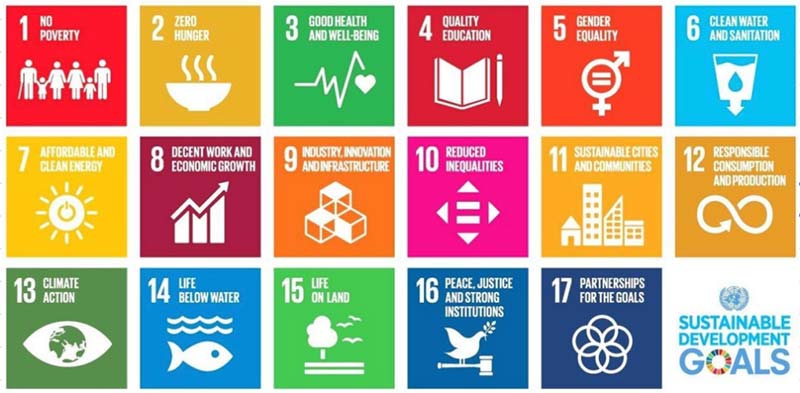
| S.No. | Sustainable Development Goal | Description |
|---|---|---|
| SDG 1 | No Poverty | End poverty in all its forms everywhere by ensuring equal access to resources, social protection, employment opportunities, and essential services, thereby improving the quality of life for vulnerable populations. |
| SDG 2 | Zero Hunger | End hunger, achieve food security, improve nutrition, and promote sustainable agriculture to ensure that everyone has access to sufficient, safe, and nutritious food. |
| SDG 3 | Good Health and Well-being | Ensure healthy lives and promote well-being for people of all ages by improving healthcare, reducing diseases, promoting mental health, and achieving universal health coverage. |
| SDG 4 | Quality Education | Ensure inclusive, equitable, and quality education while promoting lifelong learning opportunities to develop knowledge, skills, and innovation. |
| SDG 5 | Gender Equality | Achieve gender equality and empower all women and girls by eliminating discrimination, violence, and unequal opportunities in education, employment, and leadership. |
| SDG 6 | Clean Water and Sanitation | Ensure the availability and sustainable management of clean water and sanitation for all by improving water quality, sanitation facilities, and water resource management. |
| SDG 7 | Affordable and Clean Energy | Ensure access to affordable, reliable, sustainable, and modern energy by expanding renewable energy sources and improving energy efficiency. |
| SDG 8 | Decent Work and Economic Growth | Promote sustained, inclusive, and sustainable economic growth by creating productive employment opportunities, ensuring decent work conditions, and encouraging entrepreneurship. |
| SDG 9 | Industry, Innovation and Infrastructure | Build resilient infrastructure, promote sustainable industrialization, and foster innovation through research, technology, and improved transportation and communication systems. |
| SDG 10 | Reduced Inequalities | Reduce inequality within and among countries by promoting social, economic, and political inclusion and ensuring equal opportunities for all. |
| SDG 11 | Sustainable Cities and Communities | Make cities and human settlements inclusive, safe, resilient, and sustainable by improving housing, transportation, urban planning, and disaster resilience. |
| SDG 12 | Responsible Consumption and Production | Ensure sustainable consumption and production patterns by minimizing waste, promoting recycling, improving resource efficiency, and encouraging environmentally responsible practices. |
| SDG 13 | Climate Action | Take urgent action to combat climate change by reducing greenhouse gas emissions, strengthening resilience, and promoting climate adaptation and awareness. |
| SDG 14 | Life Below Water | Conserve and sustainably use oceans, seas, and marine resources by reducing marine pollution, protecting ecosystems, and preventing overfishing. |
| SDG 15 | Life on Land | Protect, restore, and sustainably manage terrestrial ecosystems, forests, biodiversity, and wildlife while combating deforestation, desertification, and land degradation. |
| SDG 16 | Peace, Justice and Strong Institutions | Promote peaceful and inclusive societies, ensure access to justice, reduce corruption and violence, and build accountable and transparent institutions. |
| SDG 17 | Partnerships for the Goals | Strengthen global partnerships among governments, businesses, academia, civil society, and international organizations to mobilize resources, technology, knowledge, and finance for achieving all SDGs. |
UG Program in Electronics and Telecommunication Engineering is accredited by NBA for 3 years from Academic Year 2024-25, 2025-26, and 2026-27, i.e., up to 30/06/2027.
UG Program in Computer Engineering and Information Technology is accredited by NBA for 3 years from Academic Year 2025-26, 2026-27, and 2027-28, i.e., up to 30/06/2028.


